What Size Air Conditioner Do You Need . If you have a lot of very sunny rooms you’re cooling, you may need an air conditioner that is 10% larger than the square footage/btu indicators recommend. Generally, in australia you will need 120 to 150 watt of power per square meter of floor area. What Air Conditioner Size Do I Need 5 Best Suggestions from homegearslab.com As such, you need a properly sized air conditioner, one that is suitable for your needs. Consumer reports recommends 20 btus per square foot of the living space (or spaces) you want to cool down. As a rule of thumb, the maximum ac unit size you need to install should not be more than 15% more than the btu’s you need to cool your house.
Gauge Factor For Strain Gauge. Strain gauges are used for measurement of strain and its associated stress in experimental stress analysis. As mentioned earlier, strain gauges work on the principle of the conductor’s resistance which gives you the value of gauge factor by the formula:
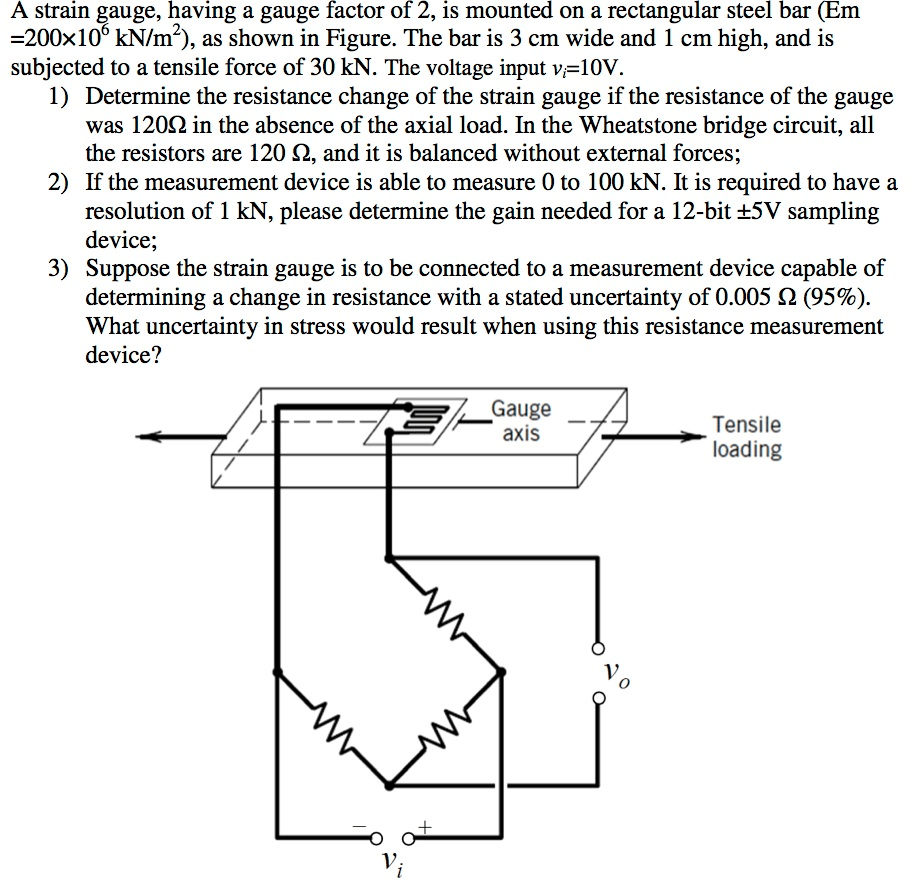
Solved A Strain Gauge, Having A Gauge Factor Of 2, Is Mou from www.chegg.com
The length of the wire is 25 mm or less. This is a number around 2. Gauge factor of strain gauge the gauge factor of strain gauge is defined as the unit change in resistance per unit change in length.
Gf = [Δr / (Rg * Ε)] Now, In Practice, The Change In The Strain Of An Object Is A Very Small Quantity That Can Only Be Measured Using A Wheatstone Bridge.
The gauge factor (for an electrical resistance strain gauge) relates the resistance change to the mechanical applied strain. In general, the gauge factor of electrical strain gauges. What is the gauge factor?
Semiconductor Strain Gauges Made Of Silicon Have A Gauge Factor About 70 To 100 Times Higher And Are Therefore Much More Sensitive Than Metallic Wire Strain Gauges.
It is also called sensitivity of the strain gauge. It is essentially the calibration of the strain gauge. Gauges are supplied with a number of initial values, normally 120ω, 350ω and 1kω.
As Mentioned Earlier, Strain Gauges Work On The Principle Of The Conductor’s Resistance Which Gives You The Value Of Gauge Factor By The Formula:
As strain of an elastic material is defined as the per unit change in length, therefore. It is denoted as k or s. The gauge factor is a proportional factor between the measured strain and the relative change in the bridge that can be measured by a suitable device supporting wheatstone bridges, such as quantumx mx1615b from hbm.
Gauge Factor Equation ( Source ).
Gauge factor is defined as the ratio of per unit change in resistance to per unit change in length. † in this tech note, the gage factor of the strain gage is identified as f g, to distinguish it from the gage factor setting of the measuring Gauge factor of strain gauge the gauge factor of strain gauge is defined as the unit change in resistance per unit change in length.
The Gauge Factor For Metallic Strain Gauges Is Typically Around 2.
Gauge factor (gf) or strain factor of a strain gauge is the ratio of relative change in electrical resistance r, to the mechanical strain. L = g f x rδl / δr l = 15 x (6)(4) / 12 l = 15 x 24 / 12 l = 360 / 12 l = 30. These are used widely for a variety of electrical transducer devices, mainly because of high accuracy and excellent reliability.


Comments
Post a Comment